OUR AMERICAN RENAISSANCE
Congress is broken – and The People can fix it!
We have a legal and peaceful plan to reclaim the power of the people to create the best government money can't buy!
Our Renaissance is a foundation created to promote discussions – and help the people reclaim their right to self-governance through the legal and peaceful process that has always existed – and it is right there in Article V of the Constitution.
Most people use the process every day in their personal, professional and public lives without even knowing it and it is the essence of the American legislative process.
The process is simple – Discuss to Agree and Do – D.A.D. That is and should be the goal of every American convention – something Our Renaissance advocates through the use of two supermajority conventions: one to propose and another to then ratify amendments.
Discussion is a powerful process. When used correctly, it can foster communication and lead to understanding and agreement, resulting in positive action.
Without discussion, there can be no exchange of ideas, no real meeting of the minds to act together to achieve common goals.
We see this almost daily in the polarization and gridlock evident in Congress.
When the Constitution created Congress, the people who wrote and adopted it specifically recognized that all power comes from the people and our Constitution provides a role for the people – together with their state legislatures through the amending process – to discuss, agree and most importantly, to act as a powerful check against Congress.
Article V of the Constitution lays out two methods to propose amendments. First, Congress itself can propose amendments any time two-thirds of both Houses agree.
Second, Congress must call a convention for the states to propose amendments if two-thirds of the states submit applications requesting that it do so.
Congress has the duty to count the applications and call a convention when the required number (currently 34) of the states have applied. It has no authority to debate or limit the count based upon subject matter. It can only count and make a call.
Congress has taken control of both methods to propose by denying, delaying and ignoring the states’ applications rather than obeying the clear and unambiguous language of Article V to call a convention.
Although 49 States have submitted hundreds of applications, Congress has never called a convention, so the states have never been allowed to propose one single amendment.
On the other hand, in the almost 250 years since the founding, over 11,000 amendments have been offered by Congress; only 27 have been adopted.
In this way, Congress has kept the power to propose for itself – and it is not letting go. There is simply no incentive for Congress to relinquish its control over the states' and people’s power to amend.
Those who control the amendment process control the Constitution – and Congress knows it!
Congress also controls the method of ratification. A properly proposed amendment requires ratification by 38 states either by their state legislatures or their state ratification conventions, as determined by Congress.
So far, Congress has used ratification by state legislatures 26 times for the 27 amendments that were adopted. In this way, Congress has failed to honor our right of self-governance by excluding the states and the people from exercising their right to amend.
Currently, the states and the people cannot be a powerful check and balance on Congress because the states must seek permission from Congress to propose an amendment, and the people must wait until Congress selects them to approve an amendment.
In the United States, the power of the government has always come from the governed – The People – and it’s time we reclaimed that power and used it as intended.

About Our Renaissance
RENAISSANCE ~ A rebirth, renewal, revival of interest
RECLAIM ~ To take back what was rightfully yours
RESTORE ~ To bring back a previous right
RENEW ~ To resume after an interruption with new life
REBOOT ~ To restart with new energy
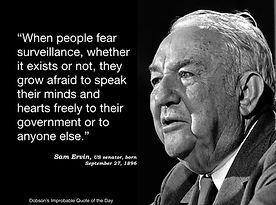
“When people fear surveillance, whether it exists or not, they grow afraid to speak their minds and hearts freely to their government or to anyone else.”
Sam Ervin, US Senator
Quiz
About Our Renaissance...
First, fix the amending process… then fix the problems
And there is no shortage of problems that demand our attention. According to the Pew Research Center, Americans express largely negative views about the current and future state of politics in the United States with nearly three-quarters saying the political system is not working well; only 4% of Americans say it is working very well. Of even more concern, trust in the federal government – which has been low for nearly two decades – is near record lows. A majority (63%) say they have little or no confidence in the future of our political system. Many Republicans, Democrats, Independents and those who identify as non-political – including non-voters – agree that our political system is broken. There are issues that could benefit from a process by which the People could fully exercise their right to self-governance without the interference and control of a self-interested, financially motivated Congress. If Congress won’t act, shouldn’t The People be allowed to act – as was intended by the Constitution? Matters needing reform decades ago have been festering from neglect, including a balanced budget, Social Security solvency, money in politics, term limits, and Congressional insider trading to name just a few. Additionally, concerns like AI, the scope of Executive Orders and Presidential Pardons, as well as foreign ownership of US property, industry, and online entities like Tik-Tok are emerging. Unless they are addressed soon, these issues will also be allowed to grow and fester as will the People’s disgust and distrust of their government. Longstanding and over-riding self-interests, some of them financial, prevent Congress from tackling the nation’s most pressing problems. There has been little effort on the part of Congress to exert adequate restraint or even oversight to rein in the excesses because Congress has the self-interests of accumulating and retaining money and power. ‘Big Pharma’, ‘Big Ag’, ‘Big Med’, and ‘Big Insurance’ appear to be working together for their own benefit and not for ours. ‘Big Money’ and ‘Big Tech’ contribute unprecedented amounts of unaccountable money to Congress in exchange for the undue influence they exert. ‘Big media’, specifically legacy media, has a hand in all of these, and public unions are in a class by themselves. As federal, state, and local governments wrestle for control in areas such as immigration and the environment, judicial overreach has created confusion and fostered distrust of our government and judiciary. The Constitution contains uncertainties such as the vague, undefined wording of the ‘Necessary and Proper’ Clause – and even deficiencies, such as the unlimited pardon power – that have led to the need for interpretation by the Courts. Most recently, the failure of the 25th Amendment to provide a workable mechanism in the event of possible presidential disability highlights one problem needing to be addressed. These issues could benefit from a process by which the People could fully exercise their right to self-governance without the interference and control of a self-interested, financially motivated Congress. If Congress won’t act, shouldn’t The People be allowed to act – as was intended by the Constitution?


_edited.jpg)

The States’ and The People’s Amendment is the way we obtain the best government money can’t buy.
The States’ and The People’s Amendment leaves Article V intact. The ability of Congress to propose amendments remains unchanged.
The States’ and The People’s Amendment provides a process for the States to call a proposing convention for new amendments and ratification by the States and the People.
Specifically, The States’ and The People’s Amendment: - Limits amendments to a single subject, allaying fears of a "runaway" convention. - Provides the States with authority to establish the rules and procedures for this process of amending. - Includes both in-person and remote electronic participation, removing debilitating delays and bringing the process into the 21st century. - Imposes time frames for action. - Requires approvals of proposed amendments by two-thirds of the State legislatures. - Requires approvals of proposed amendments by three-fourths of the State Ratifying Conventions to guarantee the People the right to approve all new amendments. - Separates Congress from the provision used by the States and the People to amend the Constitution.
How to fix the process…
Pass The States’ and The People’s Amendment!
Our Renaissance will be able to reach the People and their state legislatures drawing on the power of new technologies to educate the People about the important role they play in our Constitutional republic and to engage them in reclaiming their right as intended at the nation’s founding. Instead, the process can be fixed by using the second method – an application by two-thirds of the States (currently 34) for Congress to call a proposing convention to pass The States’ and The People’s Amendment. It can be passed using a process very similar to that described in the amendment itself. The States’ and The People’s Amendment requires that each State’s application may only consist of one single subject. Further, each State must immediately notify all the others that it has submitted an application to Congress. In this way, Congress will no longer be able to delay, deny, or ignore the States’ applications for a proposing convention. Once applications have been received from 34 States, Congress must call for a proposing convention so the States may discuss and agree and if at least that many States approve the final language, then the Amendment will go on to the final step in the process. Lastly, in order for an Amendment to become part of the Constitution, it must be ratified by either 38 State legislatures or State Ratifying Conventions, as determined by Congress.
Independent authoritative sources agree for the need to amend the process of amending the Constitution...
Renewing Federalism by Reforming Article V Defects in the Constitutional Amendment Process
Could a revision that eliminates the control of Congress create a greater role for the people acting through their states in the amending process?
Michael B. Rappaport is a Professor of Law at the San Diego School of Law and provides an examination of why the constitutional amendment procedure in Article V is defective and prevent it from being used as originally intended.
He also serves as the Director of the Center for the Study of Constitutional Originalism and is a Visiting Fellow at the Hoover Institution.

ABOUT ROBIN HULT
Our Renaissance Foundation, Founding Director
For decades I have been a Certified Public Accountant, tax advisor and an expert in proving tens of millions of dollars in economic damages for injured parties throughout the United States. My job is to know the law, identify the best strategic outcomes for my clients, and then coach them in how to best achieve their agreed-upon goals. My professional experience has taught me that discussion is crucial for agreement and agreement leads to getting things done. I consistently prove knowledge is power and that goals are best achieved by the process of Discussing to Agree and Do. (D.A.D.) Following graduation with a B.S. in Business with honors (cum laude) from the University of Colorado, I spent 5 years attending evening classes of the University of Denver, Sturm College of Law Master of Taxation Program while gaining three years of experience and training at PricewaterhouseCoopers, a “Big Four” international accounting and consulting firm. Since 1990, I have been providing highly personalized investment, tax and financial consulting to individuals, small businesses and publicly traded corporations and their owners. I am the founding shareholder of Hult CPA Firm PC, in Boulder, Colorado and have held professional licenses in the real estate, insurance and securities industries. I was previously married for 25 years and have two adult sons. I have had a lot of fun playing and coaching recreational football and basketball for most of my life and sports have taught me the valuable life lessons of preparation, discipline and teamwork. Currently, my passion is working toward an American Renaissance where all just powers of government come from the consent of the people and to restore the balance of power between the state and federal governments as first envisioned at our founding.

ABOUT MELISSA DAVIS
Our Renaissance Foundation, Founding Director
Even more than classes in law school, my experience practicing Constitutional law taught me how our federal and state systems were supposed to work to bring about the will of the people – and how easily that system could be thwarted and fail. A dozen years spent as an attorney for the Colorado State General Assembly, the Office of the Governor, and The Department of Health followed time at The National Conference of State Legislatures researching and drafting reports requested by over 7,000 state lawmakers in the fifty states. At the state level, I researched and drafted legislation, amendments, briefed legislators, testified before state and federal committees, as well as citizen groups and the media, regarding legislation, Supreme Court rulings, and developing trends in law. Sometimes the intent of the people – working through their elected representatives – was achieved. Other times, the effort fell short or missed the mark. And there were instances when it was ignored altogether, diverted for the benefit of a special interest group, big donors, partisan interests, and even individual legislators. After serving the legislative, executive and judicial branches of the state government, as well as the administrative side, I returned to my first love – teaching. Following a decade teaching history and government in parochial schools, I founded a tutoring service to provide individualized assistance to support remote learning for students from middle-school through graduate school, including special needs students. As a ‘near-native’ Coloradoan – from age 7, I attended college and law school in Denver after playing competitive tennis in high school. Football and hockey were – and still are passions, along with music, and I put in years at Mile-High stadium waiting for a winning season before the Broncos finally won some Super Bowls. I have deep ties to the Rocky Mountains and love living at the base of America’s Mountain – Pikes Peak. A daughter of Greek immigrants on one side and Pilgrims on the other – separated by 300 years – working for an American Renaissance is a continuation of my lifelong commitment to the country I love. My traditional resumé follows. Professional Experience, Attorney at Law Attorney at Law Colorado Department of Health Administrative Law Judge Presided over and ruled on licensure adjudications Attorney Argued licensure revocation actions and recommendations for criminal prosecutions (2nd chair to Office of the Colorado Attorney General) Policy Analyst Drafted regulations implementing state and federal statutes governing patient rights, including: advanced directives, fire safety in long-term care facilities, and ‘The Patient Bill of Rights’ model for nationwide and federal adoption State of Colorado, Office of the Governor Special Counsel for patient Bill of Rights, advanced directives, fire safety in long-term care facilities Colorado General Assembly, General Counsel Drafted legislation and amendments in the areas of health care, patients’ rights, and education Reviewed existing Colorado statutes for compliance with both the state federal constitutions, and Supreme Court decisions Publications “Religion in the Liverpool of The Beatles’ Childhoods” in McGowan, Michael, Ed., Speaking Words of Wisdom: The Beatles and Religion, Penn State University Press, 2024 “Beatlemania!” in Womack, Kenneth, Ed., The Beatles in Context, Cambridge University Press, 2021 The Beatles Bibliography: A New Guide to the Literature, First Supplement (with Michael Brocken, 2014) The Beatles Bibliography: A New Guide to the Literature (with Michael Brocken, 2012) Report to the State Legislators: Tort Reform Legislation and State Compliance Under the Omnibus Reconciliation Act Forthcoming: The Next Beatles’ Bibliography As editor: Imagining All The People: Poetry Inspired by the Characters in the Lyrics of The Beatles (Marcus Bradley) The Strength-Building Parent: Tools To Nurture Your Child’s Best Self (Steven Baron, PhD) Strength-based Teaching Strategies for Teachers (Steven Baron, PhD) Cultural Capital: The Beatles in Canada (Mary-Lu Zahalan) Nation Shall Speak Peace Unto Nation: ‘All You Need Is Love’ (Angela Ballard) It’s The Word: A Consideration of Beatle Historiography – 1961 to the Present (Rose Rojas) Education Liverpool Hope University, MA: The Beatles: Popular Music and Society (cum laude) Dissertation: A Contextual Analysis of the Reception of The Beatles in America in February 1964 University of Denver, Juris Doctor University of Denver, MA History (English Renaissance) University of Denver, BA Majors: History, English Literature Minors: Political Science, Education
Our Renaissance is an educational foundation applying for a 501(c)(3) designation from the IRS which provides for tax-deductible donations to charitable and educational organizations. The process is lengthy, but will allow all donations to be tax deductible by the donor – even before the 501(c)(3) status is approved.
Colorado Registration Number: 20263002854 Federal EIN: 39-2105212